Introduction
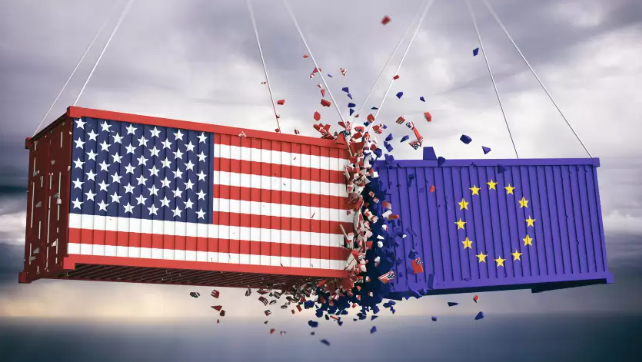
Trade relations between the United States and the European Union have entered a new and increasingly complex phase. Once described as the backbone of the global liberal trading system, the transatlantic economic partnership is now under pressure from renewed tariff policies, protectionist rhetoric, and geopolitical uncertainty. Recent developments around tariffs imposed or proposed by both sides have reignited fears of a prolonged trade confrontation, with consequences far beyond Washington and Brussels.
This article provides an in-depth analysis of the current US–EU tariff situation, examining its origins, political motivations, sectoral impacts, and broader implications for the global economy. It also explores possible future scenarios and what they mean for businesses, investors, and policymakers.
Historical Context: From Strategic Partners to Trade Rivals
For decades, the United States and the European Union promoted free trade as a cornerstone of economic growth. Together, they account for roughly one-third of global GDP and remain each other’s largest trading partners in goods and services. Despite periodic disputes—over aircraft subsidies, steel, or digital taxes—the relationship was generally stable and predictable.
However, this balance began to shift in the late 2010s with the rise of economic nationalism in the US. Tariffs increasingly became a political tool rather than a purely economic one. The concept of “strategic autonomy” in Europe and “America First” in the US marked a departure from traditional multilateralism and laid the groundwork for today’s tensions.
The US Tariff Strategy: Protectionism Returns
Political Motivation
The current US tariff approach is driven by a combination of domestic political considerations and strategic goals. Tariffs are framed as a means to:
- Protect domestic manufacturing and industrial jobs
- Reduce trade deficits
- Counter what Washington considers “unfair trade practices”
- Strengthen national security through supply-chain reshoring
From a political standpoint, tariffs resonate strongly with voters in industrial regions, making them an attractive policy tool during election cycles.
Economic Rationale and Criticism
Supporters argue that tariffs give American producers a competitive edge and reduce dependence on foreign suppliers. Critics, however, point out that tariffs function as a tax on imports, ultimately raising costs for US businesses and consumers.
In the case of European imports—particularly automobiles, machinery, chemicals, and industrial components—tariffs disrupt deeply integrated transatlantic supply chains rather than protecting purely domestic industries.
Europe’s Response: Retaliation and Legal Pressure
Counter-Tariffs and Defensive Measures
The European Union has consistently opposed unilateral US tariffs, labeling them economically harmful and legally questionable. In response, Brussels has adopted a dual strategy:
- Targeted retaliatory tariffs on US exports, often aimed at politically sensitive sectors
- Legal challenges through international trade mechanisms, including the World Trade Organization
These countermeasures are designed not only to offset economic damage but also to apply political pressure on Washington.
Strategic Autonomy and Industrial Policy
Beyond immediate retaliation, the tariff conflict has accelerated Europe’s push for “strategic autonomy.” This includes:
- Reducing dependence on US and Chinese supply chains
- Increasing subsidies for key industries such as semiconductors, energy, and defense
- Strengthening internal EU production capacity
While intended as a defensive response, these policies also contribute to a more fragmented global trade environment.
Sectoral Impact: Who Wins and Who Loses?
Automotive Industry
The automotive sector is one of the most affected by US–EU tariff tensions. European car manufacturers rely heavily on the US market, while American brands depend on European components.
Higher tariffs:
- Reduce export volumes
- Increase vehicle prices
- Push manufacturers to reconsider production locations
In the long term, this may accelerate regionalization of car manufacturing, reducing efficiency and increasing costs.
Industrial Goods and Machinery
European machinery and industrial equipment face higher barriers to the US market, impacting small and medium-sized exporters in particular. Many of these firms lack the financial flexibility to absorb tariff costs or rapidly shift production.
Agriculture and Consumer Goods
US agricultural exporters are often targeted by EU retaliatory tariffs. This affects farmers and food producers, especially in politically influential regions. At the same time, European consumers face higher prices for certain imported goods, contributing to inflationary pressure.
Macroeconomic Consequences
Inflationary Pressure
Tariffs increase the cost of imported goods, which feeds directly into consumer prices. In both the US and Europe, this complicates efforts by central banks to control inflation, particularly during periods of economic slowdown.
Trade Diversion and Inefficiency
As tariffs distort trade flows, companies seek alternative markets and suppliers. While this can benefit third countries, it often leads to less efficient supply chains and higher overall costs.
Impact on Global Trade Governance
The US–EU tariff conflict weakens the credibility of global trade institutions. When major economies bypass or challenge multilateral rules, smaller countries are more likely to follow suit, accelerating the fragmentation of the global trading system.
Geopolitical Dimension
The tariff dispute cannot be viewed in isolation. It intersects with broader geopolitical dynamics, including:
- Competition with China
- Energy security concerns
- Defense and technology cooperation
- Diverging approaches to industrial subsidies
Ironically, while the US and EU share strategic interests, trade conflicts undermine their ability to present a unified economic front in a more competitive world.
Business and Investment Implications
Corporate Strategy Adjustments
Companies operating across the Atlantic are increasingly forced to:
- Reevaluate supply chains
- Localize production
- Increase prices or reduce margins
- Delay or cancel investment plans
Uncertainty, more than tariffs themselves, is often the most damaging factor.
Investor Sentiment
Markets generally react negatively to trade uncertainty. Persistent tariff tensions increase volatility, discourage long-term investment, and raise risk premiums, particularly in export-oriented sectors.
Possible Future Scenarios
Scenario 1: Managed De-Escalation
Under this scenario, the US and EU reach partial agreements that cap tariffs, introduce exemptions for key sectors, and restore a degree of predictability. This would stabilize markets but not fully reverse protectionist trends.
Scenario 2: Prolonged Trade Standoff
Tariffs remain in place, negotiations stall, and both sides normalize a higher-tariff environment. Businesses adapt, but growth potential remains constrained.
Scenario 3: Escalation into a Full Trade Conflict
A breakdown in diplomacy could lead to broader and more aggressive tariff measures. This scenario would have serious consequences for global growth and financial stability.
Conclusion
The current US–EU tariff situation reflects a deeper transformation in the global economic order. Trade is no longer viewed solely as a tool for efficiency and growth, but as an instrument of power, security, and domestic politics.
While both sides seek to protect their interests, the long-term costs of sustained tariff tensions are significant: higher prices, reduced competitiveness, fragmented supply chains, and weakened global cooperation. The challenge for policymakers is to balance strategic objectives with economic reality.
Ultimately, the future of transatlantic trade will depend not only on tariff levels, but on whether the US and Europe can redefine their partnership in a world where globalization is no longer taken for granted.